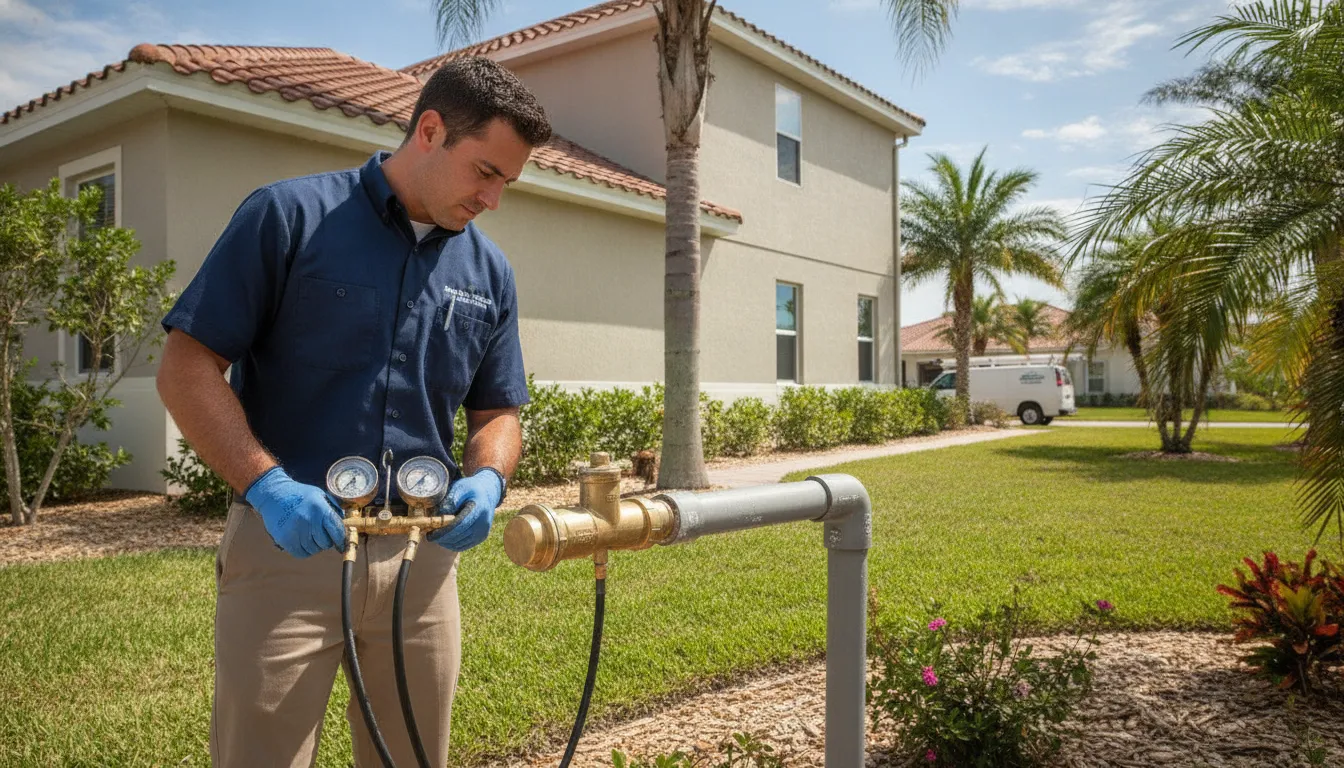
If a water provider sends a testing notice, choosing a certified backflow tester is not just a matter of finding someone with a pressure gauge. The tester must understand the backflow prevention assembly at your property, follow the applicable testing procedure, document the results, and know what happens if the device does not pass. For Treasure Coast homeowners, property managers, and light-commercial owners, that process can be easier when you know what to ask before the appointment.
Ask Plumbing by Bishop about backflow testing for your Treasure Coast property.
This guide explains the difference between tester certification, a backflow test, repairs, and ongoing compliance. It is educational, not a substitute for the current instructions from your water provider or local authority. Requirements can vary by service area, property use, device, and water-system policy.
What does a certified backflow tester do?
Quick answer: A certified backflow tester evaluates a testable backflow prevention assembly using the required procedure and properly calibrated equipment. The tester records whether the assembly performs within the applicable limits, identifies conditions that require attention, and provides the test documentation needed by the property owner and, when required, the water provider or other authority.
Backflow prevention assemblies are mechanical devices that help keep nonpotable water from moving into a potable water system. The Florida Department of Environmental Protection explains that these devices contain internal components that can be affected by fouling, wear, or fatigue. A visual inspection may show that an assembly is present, but it cannot prove that the internal checks and relief components respond correctly.
The word certified matters because a property owner may need more than a general plumbing inspection. The tester should have training and a current credential accepted by the authority that oversees the property's water service. That authority may have its own approved-tester list, form, portal, deadline, or reporting instructions. Before booking, ask which credential the tester holds, whether the local utility accepts that credential, and who will receive the completed report.
A tester does not automatically make every repair, replace every assembly, or decide the requirements for a water utility. The tester's role is to perform and document the test. A plumber or qualified repair professional may then correct a failed assembly, and the authority may require a new test after that work.
Why do property owners need a backflow test?
Quick answer: A backflow test provides performance information about a safety device that cannot be confirmed by looking at the pipe alone. It helps identify worn, fouled, damaged, or improperly functioning components before a cross-connection creates a water-quality concern. Testing also creates a record for the property owner and the authority that administers the local program.
Backflow can happen when water pressure changes direction. A pressure drop in the public supply can contribute to backsiphonage, while higher pressure on the property side can contribute to backpressure. Irrigation systems, pools, hose connections, fire protection systems, boilers, and commercial equipment are examples of situations that may create a cross-connection or a condition requiring protection.
The Florida DEP describes a cross-connection as a temporary or permanent connection between a potable water system and a source containing nonpotable water or another substance. The agency also explains that mechanical backflow preventers need periodic testing with properly calibrated gauge equipment. That is why a tester's report is more useful than a quick visual check that only confirms the assembly is installed.
Testing is not meant to predict every plumbing failure. It answers a narrower but important question: did this assembly perform as required at the time it was tested? The property owner still needs to follow the local due date and respond to any repair or retest instructions.
What is the difference between certification, testing, repair, and compliance?
Quick answer: Certification refers to the tester's training or credential, testing measures the assembly's performance, repair corrects a problem, and compliance means completing the required process for the applicable authority. These are related steps, but they are not interchangeable. A certified tester can find a failure, but the property is not fully compliant until the required repair, retest, report, and follow-up are completed.
| Term | What it means | What the property owner should confirm |
|---|---|---|
| Tester certification | The professional's training or credential for performing backflow assembly tests. | Does the local water provider accept the tester's credential? |
| Backflow test | A documented performance check using the procedure and equipment required for the assembly. | Which device was tested, when is the report due, and where is it sent? |
| Repair | Work to correct a failed, damaged, dirty, leaking, or otherwise deficient assembly. | What failed, what work is recommended, and is a retest required? |
| Ongoing compliance | Keeping up with the local program's notices, deadlines, reports, repairs, and retests. | Who tracks the next due date and keeps the records? |
Keeping these terms separate protects owners from two common misunderstandings. First, a passed test does not replace future testing when the local program requires recurring checks. Second, a repair invoice is not necessarily the same as a completed compliance record. Ask for copies of the test report, repair documentation, and any submission confirmation that applies to your property.
What happens during a backflow test?
Quick answer: A backflow test normally begins with identifying the assembly and checking the site conditions needed for safe access. The tester then uses the appropriate test procedure and gauge equipment, records the readings, and explains whether the device passed or needs attention. The exact sequence depends on the assembly type and the local authority's requirements.
- Confirm the appointment and device. Have the notice, previous report, or assembly information available. If the property has more than one device, confirm which assembly is due.
- Inspect access and condition. The tester needs safe access to the assembly, test ports, shutoffs, and surrounding area. Debris, landscaping, locked enclosures, or standing water can make the work more difficult.
- Identify the device type. Different assemblies have different operating principles and test procedures. Do not assume that two devices that look similar are tested the same way.
- Connect the testing equipment. The tester uses the appropriate connections and calibrated gauges to evaluate how the assembly responds under the applicable conditions.
- Record the results. The report should identify the property and assembly, document the readings or pass/fail result, and note any conditions that require follow-up.
- Explain the next step. If the assembly passes, ask when the next test is due. If it fails, ask what repair or cleaning is recommended, whether water service is affected, and when the retest must occur.
The tester should not promise a universal deadline or reporting method without checking the property's water provider. A notice from a utility, county, municipality, or other authority may contain instructions that are more specific than a general Florida overview.
How should Treasure Coast property owners prepare?
Quick answer: Start with the notice from your water provider or authority, then confirm the assembly location, access, and reporting instructions. Gather previous test or repair records, make sure gates and enclosures can be opened, and tell the tester about irrigation, pool, fire, commercial, or other connected systems. Preparation helps avoid a missed appointment and gives the tester better information about the property's history.
- Keep the notice available. It may list the due date, device, account, form, or submission destination.
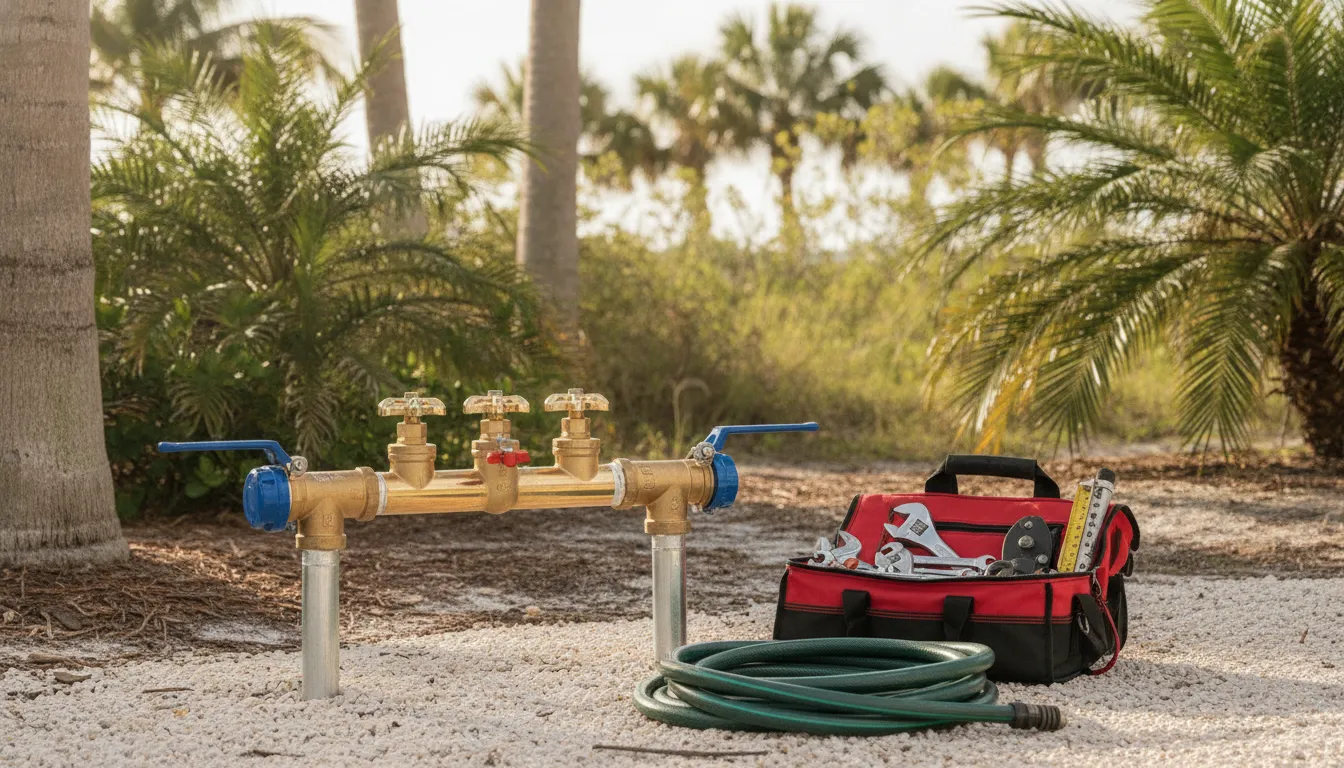
- Locate the assembly. Common locations include near the water service, irrigation connection, or another protected connection. Do not remove covers or adjust valves unless instructed by a qualified professional.
- Clear safe access. Trim back overgrowth and unlock gates or enclosures before the appointment. Do not block the assembly with storage, vehicles, or landscaping materials.
- Collect prior records. A previous report can help the tester identify the device and notice recurring issues.
- Note recent plumbing work. Tell the tester about irrigation changes, replacement devices, leaks, repairs, or construction near the assembly.
- Ask about the report. Confirm whether the tester submits it or whether the owner, manager, or contractor must send it.
- Plan for a retest if needed. A failed result may require repair before the assembly can be tested again.
For a home, the most useful preparation may be locating an irrigation backflow assembly and keeping the area accessible. For a light-commercial property, add a review of tenant spaces, equipment, irrigation, fire protection, and records held by the property manager. The goal is not to guess the rule. The goal is to make it easy to identify the right device and follow the authority's process.
What if the backflow assembly fails?
Quick answer: A failed test means the assembly did not meet the applicable performance criteria at that appointment. It does not tell you, by itself, whether cleaning, a component repair, or full replacement is the right solution. A qualified professional should explain the finding, provide the repair options that fit the device, and confirm whether the authority requires a retest or additional documentation.
Common reasons for a failed result can include debris, worn internal parts, damaged seals, leaking shutoff valves, corrosion, or a device that is not appropriate for the hazard or installation. The correct response depends on the assembly, its condition, and the local program. Avoid bypassing or removing a required device simply because it did not pass.
After repair, ask for three things in writing:
- What part of the assembly caused the failed result?
- What repair or replacement work was performed?
- Who is responsible for the required retest and report submission?
Plumbing by Bishop provides backflow testing and broader plumbing services for Treasure Coast residential and light-commercial customers. If a test identifies a plumbing repair need, the team can discuss the service path and the information needed to evaluate the issue. Review the company's plumbing services and commercial plumbing services for related work.
How can owners stay organized after the test?
Quick answer: Keep the completed test report, repair invoice, retest result, authority correspondence, and next due date together with the property's plumbing records. Assign one person to watch for notices and confirm submissions. Owners who manage multiple buildings should track each assembly separately instead of treating one successful test as proof that every device is current.
A simple compliance file can include the property address, water account information, assembly location, device type, serial or identifying information, tester details, test date, result, repair history, report recipient, and next due date. For rental, condominium, or light-commercial properties, share the relevant record with the person responsible for maintenance and keep a backup copy.
Local rules and utility processes can change. The St. Lucie County water-supply information describes the district's cross-connection control policy, while Florida DEP provides a statewide overview of cross-connection control and backflow prevention. Property owners in Martin County, St. Lucie County, and nearby Treasure Coast communities should confirm current instructions with the authority serving the specific property.
Frequently Asked Questions
Does every property need a certified backflow tester?
Quick answer: Not every property has the same device, hazard, or local requirement. If your water provider requires a testable backflow assembly to be tested, use a tester whose credential and report are accepted by that authority. Ask the water provider or review the notice before scheduling.
Is a certified backflow tester the same as a plumber?
Quick answer: A tester may also be a plumber, but the roles are not identical. Tester certification concerns the ability to perform and document the backflow test, while plumbing credentials and repair experience relate to broader plumbing work. Confirm that the person you hire can handle both the required test and any repair or retest your property may need.
How often does backflow testing have to be done in Florida?
Quick answer: There is no single schedule that should be assumed for every Florida property. The applicable water provider or authority may set the due date based on the property, assembly, and local program. Follow the notice you receive and confirm the schedule with that authority.
Can a backflow tester repair a device that fails?
Quick answer: Some testers also perform repairs, while others only test and refer repair work. Ask before the appointment. If repair is needed, confirm whether the same professional can complete it, whether parts are available, and whether the device must be retested after the work.
What should I do if I cannot find the backflow assembly?
Quick answer: Check prior reports, property records, irrigation documentation, or the water provider's notice, then ask a qualified plumbing professional to help locate it. Do not dig, adjust valves, or remove covers blindly. Safe access and accurate device identification are important parts of the testing process.
Does passing a test mean the property is compliant forever?
Quick answer: No. A passing test documents performance at a particular time. Ongoing compliance may still require future tests, reports, repairs, retests, or updated records. Keep the result and confirm the next due date with the authority serving the property.