Older galvanized plumbing rarely fails all at once. More often, a homeowner notices a pattern: water that looks rusty, pressure that has weakened. Slow flow at several fixtures, recurring leaks, or stains that return after a repair. Those clues deserve attention, but they do not prove that every pipe in the home needs immediate replacement.
Contact Plumbing by Bishop to discuss galvanized pipe replacement.
Galvanized pipe replacement may be appropriate when an inspection finds widespread corrosion, repeated failures, or restrictions that are affecting reliable water service. A localized problem may call for a repair instead. The right decision depends on the condition, extent, and accessibility of the piping, so have a qualified plumber evaluate the system before choosing a direction.
For Treasure Coast homeowners in Stuart, Palm City, Jensen Beach, Hobe Sound, or Port St. Lucie, a clear inspection report can turn a worrying symptom into a practical plan. Start by learning what aging galvanized pipe problems can look like in an older home. Then use those observations to ask focused questions about repair, partial replacement, or repiping.
What galvanized pipe problems look like in an older home
Galvanized supply piping can show its condition through everyday changes that are easy to notice. Water may look rusty or discolored when a faucet first opens. A shower or sink may have weaker flow than it once did, or the pressure may vary when more than one fixture is running. These clues can reflect buildup and corrosion inside the pipe. Rust buildup can narrow the pipe's interior and restrict water flow, which may contribute to weak pressure. Interior rust can narrow galvanized pipe and restrict flow.
Look for symptoms throughout the home rather than judging the system from one fixture alone. If several faucets have poor flow, the concern may involve more of the supply piping. If only one faucet is affected, the aerator, fixture, or a localized restriction may also deserve attention. This comparison does not identify the cause by itself, but it gives a plumber useful information to investigate.
Rusty or discolored water
Brown, yellow, or rusty-looking water can be unsettling, especially when it appears repeatedly after the water has been unused. Corrosion inside older galvanized lines is one possible explanation, but the appearance of water does not prove that every pipe in the home has failed. It is also important to separate a plumbing concern from a water-quality question. The EPA explains that lead particles can attach to galvanized pipes and later enter drinking water. If you want certainty about lead in your water, the EPA recommends having the water tested. Review the EPA's guidance on galvanized pipes and drinking water.
Until the source is clearer, avoid treating boiling as a solution for lead concerns because boiling does not remove lead. For questions about water quality, testing is more useful than relying on color alone. A plumber can evaluate accessible piping and related fixtures, while a qualified water-testing provider or local authority can address testing needs.
Low flow, leaks, and repeated repairs
Reduced flow or pressure is another common reason homeowners ask about galvanized pipe replacement. You may notice a shower that takes longer to rinse, a tub faucet that fills slowly, or pressure that drops when another fixture is used. Visible leaks, damp areas, water stains, or repeated repairs also deserve attention. An isolated leak may be repairable, while widespread corrosion can point toward a broader replacement conversation. A leak repair can limit immediate water damage without correcting corrosion elsewhere, so recurring failures should be considered as part of the larger pattern.
These symptoms are reasons to arrange an evaluation, not proof that the entire system needs replacement. A professional should consider the location and frequency of leaks, the extent of corrosion that can be seen, the effect on flow, and the accessibility of the piping. Plumbing by Bishop provides pipe repairs and repiping for Treasure Coast homeowners, including customers in Stuart, Palm City, Jensen Beach, Hobe Sound, and Port St. Lucie.
Contact Plumbing by Bishop to schedule a professional plumbing evaluation
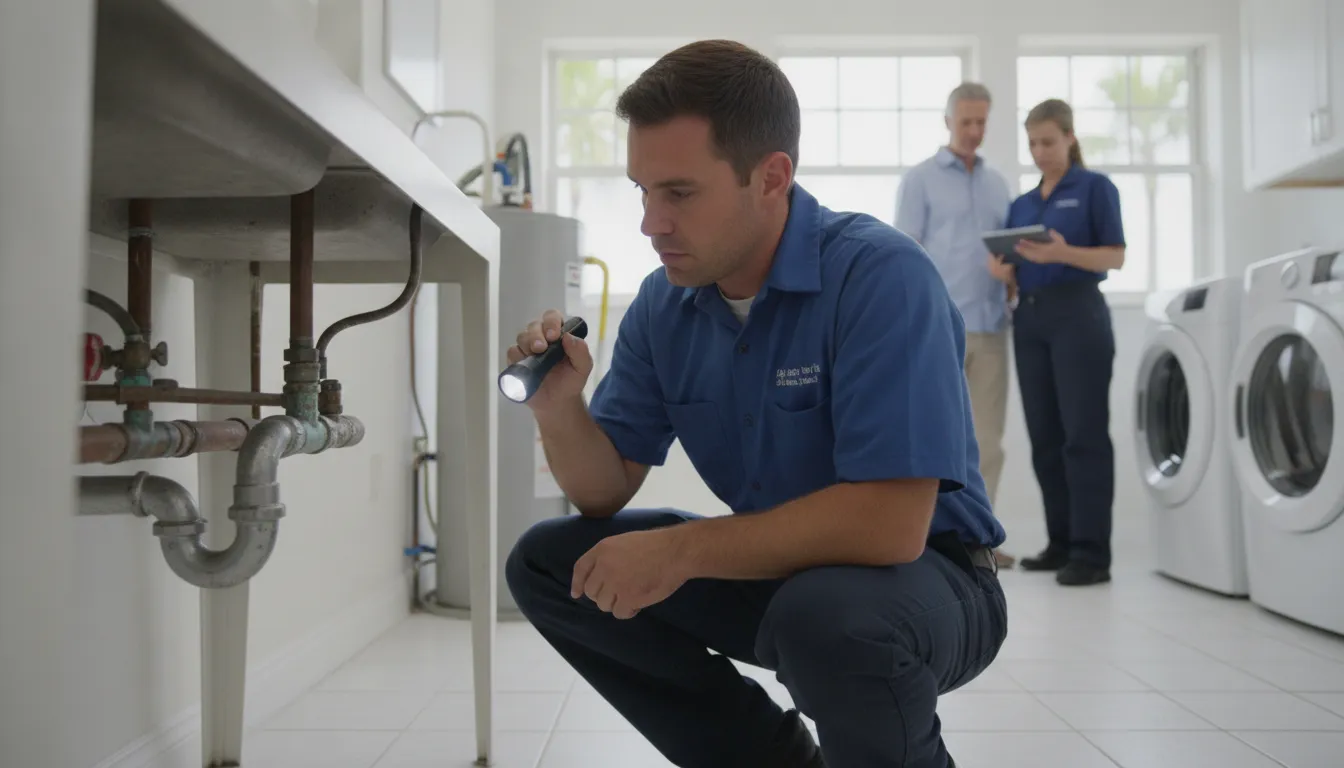
How a plumber inspects aging galvanized plumbing
A useful inspection should connect what you have noticed at home with what the plumbing system can show in person. It is not a promise that every galvanized pipe needs immediate replacement. The goal is to document the condition, identify active concerns, and explain whether a localized repair, broader work, or continued monitoring is reasonable.
- Start with your history and symptoms. The plumber should first ask when the home was built or last repiped, which fixtures have problems, and whether symptoms occur throughout the house or in one area. Share details about recurring leaks, rusty or discolored water, weak or inconsistent pressure, poor flow, stains, or recent repairs. A pattern can help distinguish a fixture issue from a concern affecting the supply piping. It also helps to mention whether the problem is worse after the water has been off or at certain fixtures.
- Review visible and accessible piping. The inspection can include galvanized pipe that is visible in areas such as a utility room, garage, crawl space, attic, or beneath accessible sinks. The plumber may look for corrosion, staining, dampness, mineral buildup, patched connections, and other signs of deterioration. This review cannot confirm the condition of every pipe hidden behind walls, under floors, or below finished surfaces. Its value is in documenting accessible evidence without opening the home unnecessarily.
- Observe fixture flow and pressure. The plumber can compare how water behaves at different fixtures and note whether flow is weak, uneven, or affected when more than one fixture operates. Rust buildup can narrow the inside of galvanized pipe and restrict flow, which may contribute to weak pressure. These observations are clues, not a complete diagnosis by themselves. A problem at one faucet may have a different cause than a pattern affecting multiple fixtures.
- Look for leak clues and related damage. Water stains, damp cabinets, peeling paint, musty areas, or repeated repairs can help identify where an active or past leak deserves closer attention. An isolated leak may be repairable, while widespread corrosion can change the replacement discussion. Stopping visible water damage does not necessarily correct corrosion elsewhere in the system, so ask the plumber to explain what the repair solves and what it cannot confirm.
- Clarify the limits and the next decision. Ask for a plain-language summary of what was seen, what remains concealed, and which findings support repair, additional investigation, or galvanized pipe replacement. If water quality is a concern, a pipe inspection is not the same as drinking-water testing. The EPA advises homeowners who want certainty about lead in drinking water to have the water tested: EPA guidance on lead in drinking water.
- Which portions of the piping were actually visible?
- Are the symptoms isolated to one fixture or present throughout the home?
- What evidence suggests corrosion, restriction, or an active leak?
- What can this non-invasive inspection not determine?
- Would a localized repair address the underlying concern?
- What would make broader replacement the more reliable option?
- What should I monitor, and how soon should I follow up?
A qualified plumber should base the recommendation on the extent and location of deterioration, accessibility, repeated failures, and your priorities for reliable water service. That inspection-led approach gives you useful information before you commit to repair or repiping.
When galvanized pipe replacement makes more sense than another repair
A localized repair can be a reasonable option when an inspection finds one accessible leak. The surrounding pipe remains in usable condition, and the homeowner wants to address an immediate problem without changing more of the system. The important distinction is that a leak repair stops the active failure. It does not automatically correct corrosion or buildup elsewhere in the galvanized piping.
Replacement deserves a closer look when the same system has developed several leaks. Water flow or pressure has declined throughout the home, or visible corrosion extends beyond one fitting or short section. Widespread corrosion typically creates a system-level concern rather than a single repair point. In that situation, repeatedly patching the newest leak may leave the homeowner responding to symptoms instead of improving long-term reliability. A professional inspection can help separate an isolated defect from a broader pattern.
| Inspection or service finding | A localized repair may fit when | Replacement discussion becomes more useful when |
|---|---|---|
| One active leak | The leak is isolated, accessible, and nearby pipe condition is acceptable. | Leaks continue to appear in other areas or corrosion is visible beyond the repair point. |
| Low or inconsistent water pressure | The inspection identifies a separate, limited cause that can be corrected. | Restricted flow appears throughout the home and the galvanized lines show interior buildup or deterioration. |
| Recurring repairs | The repair addresses a clearly defined failure and meets the homeowner's short-term goal. | Repeated repairs are becoming a pattern, and reliability is a higher priority than another temporary fix. |
| Hard-to-access piping | Opening the area is limited and the affected section can be repaired responsibly. | Access work would be repeated for multiple failures or a planned renovation creates a practical opportunity to replace piping. |
Accessibility and homeowner priorities matter as much as the visible symptom. A pipe that is easy to reach may be straightforward to repair, while several concealed problem areas can make a broader plan more practical. Some homeowners prioritize minimizing near-term disruption. Others want to reduce the chance of recurring leaks and improve confidence in the water-supply system. Neither priority creates an automatic answer, but both should be part of the recommendation.
Ask the plumber to explain which sections were inspected and what was visible. Ask what could not be confirmed without opening walls or ceilings. Clarify whether the recommendation is for a single repair, a partial replacement, or broader repiping. Plumbing by Bishop provides both pipe repairs and repiping, so an inspection can be matched to the condition actually found rather than to a one-size-fits-all rule. For an active leak or corrosion concern, see the company's professional leak detection and repair service information.
Contact Plumbing by Bishop to discuss your inspection findings and next step.
What to expect from a repiping or replacement plan
A good plan should make the work understandable before anything is opened up. It should connect the inspection findings to a practical scope of work, explain what will change, and identify the decisions that may affect your home. Galvanized pipe replacement is not a one-size-fits-all project. The recommendation should reflect the condition and layout of your plumbing rather than rely on a universal material or method.
A clear material and connection strategy
Your plumber should explain which replacement materials are being considered and why they fit the system, the installation conditions, and your priorities. Different materials can have different installation characteristics, so the important question is not which product is always best. Ask how the proposed material will connect to any piping that remains and where transition fittings will be used. Ask whether the plan replaces only a damaged portion or a broader network of supply lines.
Transition points deserve specific attention. Every connection between old and new piping should be identified in the scope, along with the fixtures or branches it serves. This helps you understand what is included and makes it easier to discuss future work if another section is not accessible during the initial project.
Access, permits, and protection for your home
Repiping may require access through walls, ceilings, cabinets, floors, or other finished areas, depending on where the lines run. A responsible plan should identify the expected access points and describe how the crew will protect nearby surfaces, furniture, and belongings. It should also explain what restoration is included after the plumbing work, such as closing access openings or coordinating finish repairs. The exact restoration responsibilities should be clear before scheduling.
Permits or inspections may apply depending on the project and local requirements. Rather than assuming, ask whether permits are needed, who will handle any permit process, and whether an inspection is part of the schedule. This keeps responsibilities clear and avoids surprises as the work progresses.
Testing, scheduling, and communication
Before the work is considered complete, the plan should include pressure or leak testing appropriate to the installation. The plumber should explain what is being tested, when testing will occur, and how any issue will be addressed. Testing is a useful quality-control step, but it does not replace a clear explanation of the completed scope.
Scheduling should cover the expected work sequence, areas that may be temporarily unavailable, water shutoffs, and the best way to communicate changes. Ask who your point of contact will be and how you will receive updates if concealed conditions affect the plan. Professional pipe repairs and repiping are part of Plumbing by Bishop's full-service plumbing work, including service for residential and light commercial properties. If corrosion or an active leak needs attention while you are evaluating the broader project, learn about plumbing repairs and leak detection. A measured plan gives you the information needed to decide whether replacement is the right next step for your home.
How Treasure Coast homeowners can plan the decision
Choosing what to do about galvanized plumbing does not have to be an all-or-nothing decision made from one symptom. A practical plan starts by documenting what you are noticing, then having the accessible portions of the system evaluated by a qualified plumber. Write down where water looks discolored, which fixtures have weak or inconsistent flow, when leaks appeared, and whether the same area has needed repeated repairs. Photos of stains, corroded fittings, or repaired sections can also help explain the pattern during an appointment.
Ask the plumber to separate confirmed findings from possibilities. Useful questions include: Which sections were visually inspected? Were flow or pressure concerns checked at more than one fixture? Is the issue isolated, or does corrosion appear in multiple accessible areas? What can the evaluation confirm without opening walls or floors? A non-invasive review may identify important evidence, but it may not show the condition of every concealed pipe.
Request a written explanation of the available scope. Depending on the findings, that could mean repairing one accessible leak, replacing a localized section, or planning broader galvanized pipe replacement or repiping. Ask what problem each option is intended to solve and what access is required. Ask whether permits or testing are part of the plan, and how openings will be protected and restored. If the concern is poor flow, distinguish interior supply-pipe restrictions from other possible causes rather than assuming the galvanized pipe is responsible.
Household priorities matter as much as pipe condition. A homeowner planning a bathroom remodel may want to coordinate plumbing work before new finishes are installed. Someone who depends on consistent water service may place greater weight on reducing repeated disruptions. Residents in Stuart, Palm City, Jensen Beach, Hobe Sound, or Port St. Lucie can ask for a plan that accounts for the home's layout, accessible work areas, and the practical needs of the household. Plumbing by Bishop provides pipe repairs and repiping across the Treasure Coast, including these communities.
Finally, compare recommendations by clarity, scope, testing, access, and restoration, not by a vague promise that every older system needs immediate replacement. The right next step is the one supported by the inspection and suited to the condition of your home. The FAQ below addresses common questions homeowners ask before scheduling that evaluation.
Contact Plumbing by Bishop to review your inspection findings.
Frequently Asked Questions
What should I replace galvanized pipe with?
There is no single best material for every home. A plumber may discuss options such as PEX, copper, or another approved material after considering the existing layout, access, connections, local requirements, and the system's condition. The recommendation should fit the home and the scope of work rather than follow a one-size-fits-all rule.
Is it worth replacing galvanized pipes?
Replacement may make sense when corrosion is widespread, flow and pressure problems keep returning, or repeated leaks show that isolated repairs are no longer a dependable long-term solution. A localized issue may be repairable. Have a qualified plumber inspect accessible piping and explain what the findings support before deciding on whole-home replacement.
How do I know whether the pipes are affecting my water?
Rust-colored or discolored water, poor flow, and recurring leaks are reasons to request an inspection, but they do not by themselves prove a specific cause. If you are concerned about lead in drinking water, the EPA recommends having the water tested for certainty. EPA guidance also says to use cold water for drinking and cooking when reducing potential exposure.
Will insurance cover galvanized pipe replacement?
Coverage depends on the policy, the cause of the damage, exclusions, and whether the work addresses a sudden leak or aging materials. Ask your insurer what documentation it needs before authorizing work. A plumbing inspection report can help explain the observed condition, active damage, and recommended scope, but it does not guarantee coverage.
What should I ask during a galvanized pipe inspection?
Ask which sections were accessible, what symptoms the findings explain, whether corrosion appears localized or widespread, and what risks remain after a repair. Also ask the plumber to compare a targeted repair, partial replacement, and repiping plan, including access, testing, and restoration steps. Clear answers make the decision easier without assuming every older system needs immediate replacement.
Contact us to discuss your galvanized pipes
If you notice recurring leaks, discolored water, or changing water flow, contact a plumber for a clear evaluation. A professional conversation can help you understand what the inspection findings mean and which options fit your home. Contact Plumbing by Bishop through the verified contact page to discuss your symptoms, inspection, repair, or replacement options.