
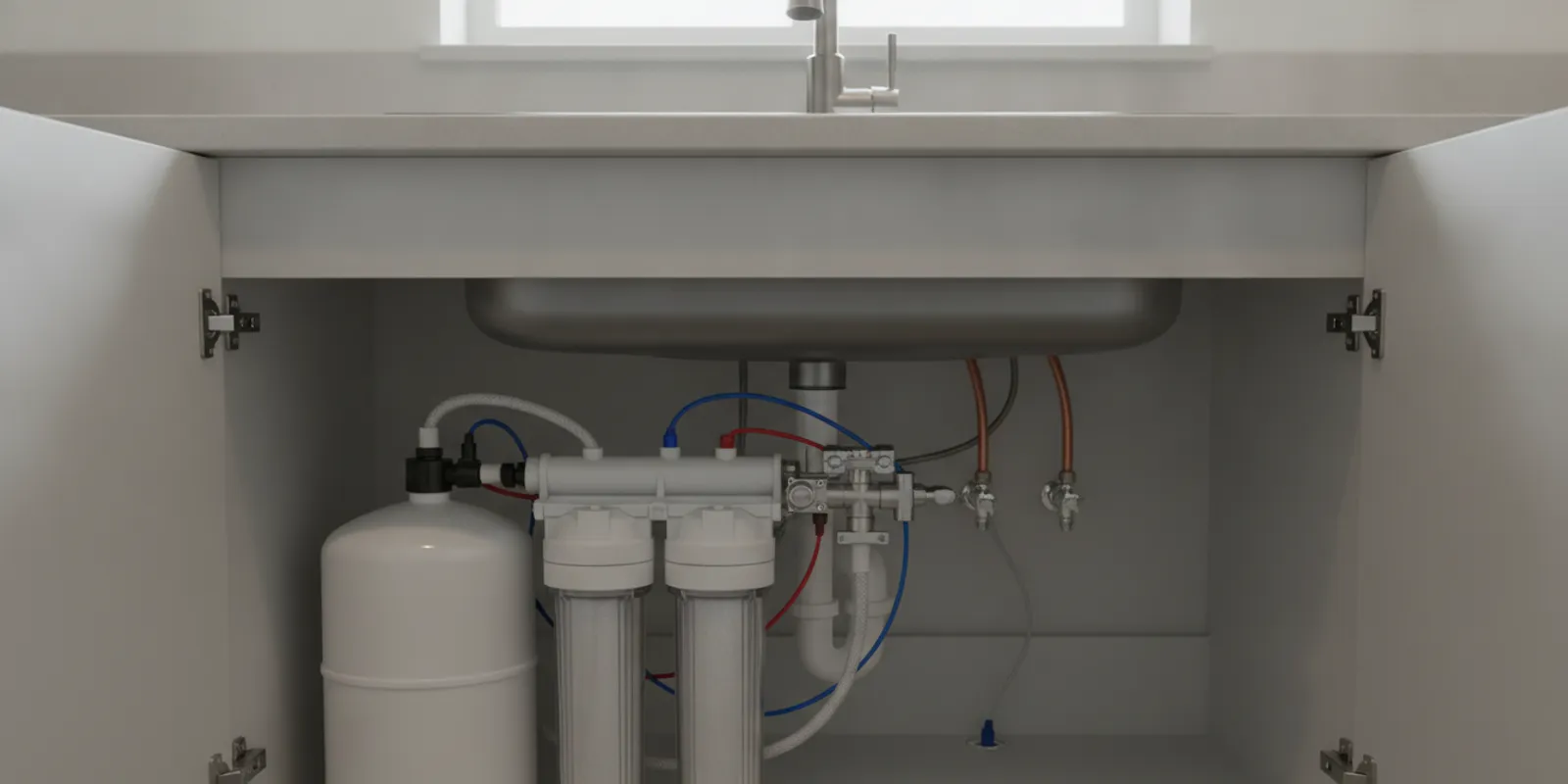
If you are comparing a reverse osmosis water filter for drinking and cooking water, start by identifying what you want the system to address. Reverse osmosis, often shortened to RO, is a membrane-based treatment method. It can reduce some substances in water, but no single system is right for every home or every water concern. The source water, product certification, installation location, and upkeep all matter.
Ask about water-treatment guidance
What does a reverse osmosis water filter do?
An RO system uses water pressure to move water through a semipermeable membrane. The membrane separates some dissolved material from the water that passes through it. The filtered water is collected for use, while a portion of the incoming water carries separated material away as drain water. Many household systems combine the membrane with other filter stages, such as sediment or carbon filters.
Those stages have different jobs. A sediment filter may catch particles that could affect later components. Carbon filtration may help with certain tastes or odors, depending on the product and the water. The RO membrane is the central separation stage. The exact order and components vary, so check the product documentation rather than assuming every unit has the same design.
RO is not a magic label that means every possible contaminant has been removed. Treatment performance depends on the system, its condition, the water entering it, and whether it is installed and maintained as directed. The U.S. town of Hinesburg’s educational overview describes RO as a membrane filtration approach and notes its very small nominal pore size; that general description is not a guarantee about the performance of a particular household product. Review product-specific performance information for the substances you care about.
When might an RO system make sense?
A homeowner may consider an RO system when the goal is to treat water at a particular drinking-water tap, or when a water test or reliable water-quality information identifies a concern the selected system is designed and certified to reduce. Some people also compare RO systems because they want a different taste for drinking or cooking water. Taste preference alone, however, does not establish that water is unsafe or that RO is the right remedy.
Begin with the water source. Public water customers can consult the utility’s current water-quality information. Private-well owners may need testing suited to the well and local conditions. If you have a specific health concern, ask a qualified water-quality professional or relevant public-health authority what testing is appropriate. Choose a filter only after you understand what the test or water-quality report shows.
Do not select a system solely because its advertising uses broad phrases such as “pure water” or lists a long set of possible contaminants. Instead, identify the exact substance, check whether the particular model has relevant third-party certification and performance documentation, and confirm that its rated conditions match your home’s water. Certification and test claims are model-specific, not a promise that every RO system treats the same things.
What can a reverse osmosis water filter address, and what can it not promise?
Quick answer: A reverse osmosis water filter can reduce certain substances only when the specific model is tested and rated for them. It cannot promise universal contaminant removal or replace water testing and professional diagnosis.
An RO membrane can reduce certain dissolved substances when a system has been tested and rated to do so. The important phrase is “certain substances.” The label, certification, and performance data for the specific model should identify what it is designed to reduce and under what conditions. A general description of RO technology cannot tell you whether a particular system is suitable for your water.
An RO unit should not be treated as a substitute for testing, plumbing repairs, or advice about a known water problem. It cannot correct every issue in a house’s plumbing, and it does not guarantee a particular taste, health outcome, or water quality in all circumstances. It is also not necessarily the right choice for every water concern. A different treatment method, a point-of-entry system, a plumbing repair, or no added treatment may be more appropriate depending on the source and the goal.
There are practical tradeoffs as well. Many under-sink RO systems send some water to a drain during operation, require space for components and often a storage tank, and need periodic filter replacement. Water pressure and installation details can affect how a system works. Ask the manufacturer or installer how the model performs in the conditions expected at your home rather than relying on a broad claim.
Where can a household reverse osmosis system be installed?
Many residential RO systems are installed beneath a kitchen sink and serve a separate drinking-water faucet. This point-of-use arrangement treats water for that fixture rather than supplying every tap in the building. It can be a practical fit when the goal is filtered water for drinking and food preparation, and the cabinet has room for the system’s filters, tubing, and any storage tank.
Before choosing an under-sink location, measure the cabinet and look for obstructions. Note the sink basin, disposal, existing filter, stored supplies, shutoff valves, drain plumbing, and available electrical outlet if the chosen product needs one. Confirm that the faucet can be mounted where intended and that the sink or countertop material can accommodate it. A compact product still needs space for access when filters are changed.
Some systems are designed for other locations or configurations. A refrigerator connection may be possible with a compatible system and properly planned tubing, but do not assume a standard RO unit can connect to every refrigerator. Whole-house RO is a different and more involved design question than an under-sink drinking-water filter. It can call for substantial consideration of water demand, storage, drain flow, pressure, and how the home’s plumbing is arranged. Get system-specific professional guidance before choosing whole-house treatment.
For a household with limited cabinet space, a different point-of-use filter or another treatment approach may fit better. If you are comparing an under-sink arrangement with other filter choices, use the available space, desired tap location, water-use habits, and upkeep access as part of the decision, rather than just the initial equipment footprint.
It also helps to distinguish a point-of-use goal from a whole-home goal. If you mainly want water from one kitchen tap, treating that one location may avoid changing the water supplied to showers, laundry, and other fixtures. If your concern applies to multiple fixtures, first establish what the concern is and which treatment approach is appropriate; do not assume that scaling up an under-sink product will solve it. A professional can review the plumbing layout, but the treatment choice should still match reliable water-quality information.
Think about daily use, too. A small storage tank, if included, has a finite capacity, and the system may need time to replenish water after heavier use. Check the manufacturer’s rated production and operating conditions, and ask how those figures relate to household pressure and water temperature. Consider where replacement cartridges will be stored and whether you can reach the unit comfortably. A system that technically fits but is hard to maintain can be a poor practical choice.
What should you compare before selecting a system?
Compare products by their documented performance and real installation requirements. The following checklist can help organize the questions. It is not a substitute for model-specific instructions or a water-quality assessment.
| Comparison point | What to check | Why it matters |
|---|---|---|
| Water concern | Identify the substance or water characteristic you want to address, using a water report or appropriate testing where needed. | A filter is useful only when its documented performance matches the goal. |
| Product performance | Review model-specific certifications, rated contaminants, conditions, and limitations. | Not all RO systems have identical components or reduction claims. |
| Installation location | Measure cabinet space and check faucet, drain, shutoff, tubing, and tank requirements. | Access and fit affect installation and future filter changes. |
| Water use and reject water | Ask how much water the system uses and sends to drain under the conditions at your home. | Water-use figures can vary with system design and operating conditions. |
| Maintenance | Confirm each filter’s replacement interval, replacement part, and maintenance instructions. | Overdue or incorrect maintenance can undermine expected performance. |
| Service and compatibility | Check local plumbing connections, pressure requirements, refrigerator compatibility, and who can service the unit. | Compatibility is specific to the equipment and the home’s setup. |
Ask for clear answers before buying: What exact model is proposed? Which specific substances is it rated to reduce? What evidence supports those claims? What does the installation include? How will the unit connect to the drain and faucet? Are any additional parts required? What maintenance is due, and how will you know when it is time?
Compare the full ownership picture, not just the equipment description. Find out which components are replaced routinely and whether the membrane has a different service interval from the other cartridges. Ask whether replacements are widely available for the model and whether the instructions require flushing after a change. These details affect how easy it is to keep the system in service, even though they do not tell you whether the treatment is needed in the first place.
Be cautious about comparing two products by a single headline number. Claims may use different test conditions, system configurations, or definitions. Read the certification listing or performance sheet for the exact model and check that it addresses the substance relevant to your water. If the document is unclear, ask the manufacturer or a qualified water-quality professional to explain it before relying on the claim. This keeps the selection tied to documented performance rather than a generic description of reverse osmosis.
What maintenance does an RO filter need?
RO systems need planned upkeep. Depending on the model, a system may have prefilters, a membrane, a post-filter, or other components, each with its own replacement or service instructions. Do not assume that all cartridges should be changed at the same interval. Follow the manufacturer’s directions for the exact model and consider the water conditions and amount of use.
The University of Michigan’s Graham Sustainability Institute water-filter guidance advises users to follow the manufacturer’s instructions and replace filter cartridges on schedule. That is a useful baseline for any household filter, including an RO system. Keep the product manual and a record of installation and filter changes. If the system includes a filter-change indicator, learn what it monitors and whether it replaces the manufacturer’s schedule.
When a filter is due, use the compatible replacement part and follow the correct procedure. A replacement may require shutting off the water, relieving pressure, flushing a new cartridge, or checking for leaks, depending on the product. If the instructions are unclear or a connection is leaking, stop and seek qualified assistance rather than forcing a fitting or continuing to use a system that may not be operating correctly.
Pay attention to changes in flow, unusual taste or odor, visible leaks, and the unit’s maintenance indicators. A change does not identify its own cause, and water appearance or taste cannot confirm that treatment is working. If performance is in doubt, check the instructions and arrange appropriate testing or service. Use a professionally qualified plumber for installation or repair questions that involve household plumbing connections.
Plan for maintenance before the system is installed. Ask which components are homeowner-serviceable and which tasks call for professional help. Make sure you know how to shut off water to the unit and how to check the connections after work. Keep receipts or a dated log of filter changes so another household member can understand what was replaced and when. If a product uses an indicator, confirm whether it measures actual use, estimates a schedule, or signals another condition; do not assume that one light covers every maintenance task.
What installation questions should you ask a plumber?
Before scheduling an installation, describe the goal and the proposed location. Share any recent water test or water-quality report and the product information for the system you are considering. A plumber can assess plumbing connections and physical fit, but specific contaminant selection and water interpretation may call for a qualified water-quality professional. Separate those roles so the system is chosen for the right reason and installed appropriately.
- Does the selected system match the water concern and the model’s documented performance?
- Where will the filters, storage tank, and dedicated faucet go, and will they remain accessible?
- Does the installation require a new faucet opening, a drain connection, an outlet, or refrigerator tubing?
- Are the home’s water pressure and existing plumbing compatible with the product requirements?
- What maintenance tasks and replacement intervals does the manufacturer specify?
- What should I do if I notice a leak, reduced flow, or a change in taste after installation?
Ask for service-specific pricing and an explanation of the proposed work before authorizing it. The price and scope depend on the system and the plumbing conditions; no single installation description applies to every home. Plumbing by Bishop serves residential and light commercial customers on the Treasure Coast and provides water-treatment or softener warranty service. You can ask Plumbing by Bishop about plumbing and installation questions.
How do you decide whether RO is the right fit?
Use a simple sequence rather than starting with a product advertisement:
- Clarify the goal. Decide whether you want to address a documented water concern, a particular drinking-water tap, or a taste preference.
- Gather reliable information. Review information about the water source and arrange testing when appropriate.
- Compare documented performance. Check the selected system's performance documents and installation requirements.
- Confirm the practical fit. Decide whether you are comfortable with the ongoing filter changes, space requirements, and water use.
If the information does not point clearly to RO, pause before purchasing. A different filter may be more suitable, or a treatment device may not be needed for the concern you have. For help assessing plumbing connections or installation options, contact Plumbing by Bishop with the system details. For questions about which contaminants to test or how to interpret results, consult a qualified water-quality professional or the relevant public-health authority.
Discuss an RO installation with Plumbing by Bishop
Frequently asked questions
Does an RO filter make all water completely pure?
No. “Reverse osmosis” describes a treatment process, not a universal guarantee. The substances reduced and the results depend on the particular product, the incoming water, operating conditions, installation, and maintenance. Check model-specific performance documentation and use testing when you need to assess a water concern.
Does every home need a reverse osmosis system?
No. The right choice depends on the water source, a specific treatment goal, and the system’s suitability. Review available water-quality information and consider testing or qualified guidance before buying a treatment system.
Can I install an RO system myself?
Some products are sold with homeowner installation instructions, but difficulty varies with the unit and the sink, drain, and faucet setup. Follow the manufacturer’s instructions. If the work involves unfamiliar plumbing connections, a new faucet opening, a leak, or compatibility questions, consult a qualified plumber.
How often should RO filters be changed?
There is no single interval for every model or cartridge. Follow the manufacturer’s schedule for each component, taking account of the product’s instructions and water conditions. The University of Michigan’s water-filter guidance likewise emphasizes manufacturer directions and timely cartridge replacement.
Can an under-sink RO system treat water throughout the house?
Most under-sink systems are point-of-use units that serve one faucet or an approved connected appliance, not every tap. Whole-house treatment has different equipment and design requirements. Confirm the intended coverage for the exact model before selecting it.
Choosing an RO system is easier when you start with a clear water-quality goal, check what a specific model can document, and plan for installation and maintenance. If you need help reviewing plumbing fit or installation questions, reach out to Plumbing by Bishop before making a decision.