
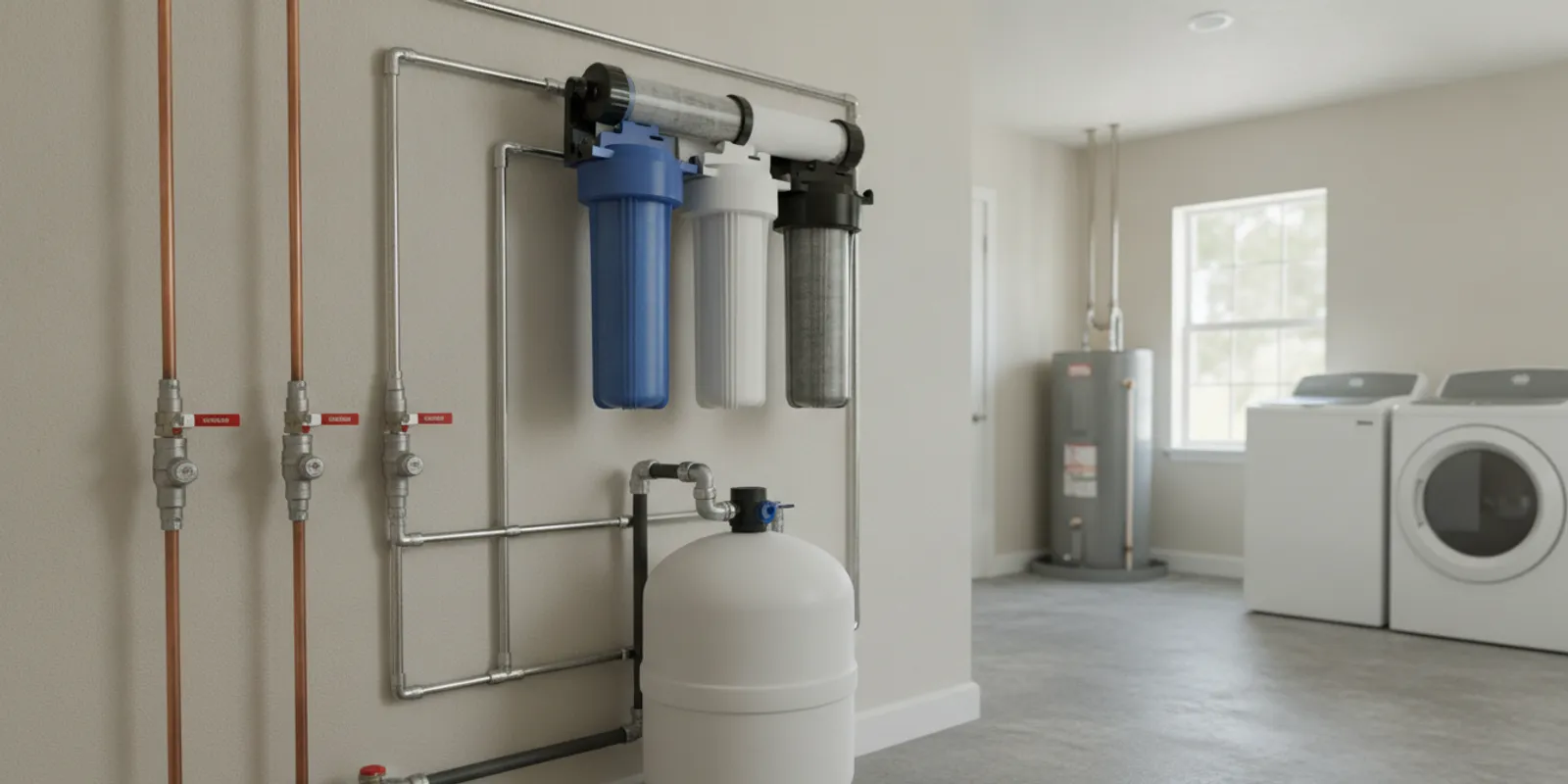
A whole house reverse osmosis system treats water for multiple fixtures rather than just one drinking-water tap. That broad coverage can be useful when a water test or a specific household need points to treatment at the point where water enters the home. But it is not automatically the right answer for every home: capacity, wastewater, pretreatment, maintenance, and installation space all matter. This guide can help you decide what to ask before moving forward.
Talk with a plumber about your water-treatment needs
What Is Different About Whole-House Reverse Osmosis?
Reverse osmosis, or RO, uses a membrane as part of a water-treatment process. A whole-house setup is designed to supply treated water to multiple parts of the plumbing system. That is different from a point-of-use unit, which treats water at a selected faucet or appliance. A whole-home design may include prefilters, an RO membrane, storage, pumps or controls, and other equipment; the specific arrangement depends on the water supply, the system, and the expected demand.
The Environmental Protection Agency describes point-of-use RO systems as potentially able to remove certain contaminants, including lead, volatile organic compounds, PFAS, arsenic, bacteria, and viruses. That information is about point-of-use RO and should not be treated as a performance guarantee for a particular whole-house unit. Ask for documentation for the exact system and contaminants you want addressed. The EPA overview is available at Point-of-Use Reverse Osmosis Systems.
RO also should not be selected based on a broad promise that it will make any water “perfect.” Start with the source, a clear description of the concern, and reliable water-test results. A system needs to be chosen for the actual supply and installed so it can serve the home's plumbing as intended.
When Might a Whole-House System Be Worth Considering?
A whole-house RO system may be worth investigating when treatment is needed at many fixtures, when a water analysis identifies a concern that the proposed system is certified or otherwise documented to address, or when a household has an unusual water requirement. A qualified water-treatment provider can help determine whether whole-home treatment is appropriate or whether treating water at selected taps would meet the goal with less equipment and less treated-water demand.
It may be unnecessary if the concern involves only drinking water at one sink, if another treatment method is a better match for the test results, or if the household cannot accommodate the equipment and ongoing service. RO is one option among several. A useful recommendation should explain why it fits your water, what it will and will not address, and what the alternatives are. For an overview of broader system choices and planning, see this water filtration system installation guide.
Make the decision by writing down the reason you are considering treatment before discussing equipment. For example, your goal may be to address a specific result on a laboratory report, provide treated water to several bathrooms, or reduce a particular taste or odor. These goals are not interchangeable. A concern about taste does not by itself establish that whole-home RO is necessary, and a system selected for one documented condition may not address another. Ask the provider to connect each recommendation to a test result or a clearly stated use.
It can also help to list the fixtures that matter most. Think about drinking and cooking taps, showers, laundry, ice makers, and any equipment that uses water regularly. Mark which ones need treatment and which do not. This simple list gives the installer a more useful starting point than the general instruction to treat everything. It may also reveal that point-of-use equipment or another treatment method is a better match for the household's actual needs.
How Much Treated Water Does Your Household Need?
Capacity is about more than the number of people in the home. Consider how many fixtures may run at once, whether treated water is intended for showers and laundry as well as drinking and cooking, and whether the household has high-demand uses. A system sized only around a small drinking-water need may not keep up with whole-home demand. Conversely, designing every outlet for treatment could require more equipment and operating attention than the household needs.
Ask the installer to explain the system's rated production under the conditions expected at your home, how water is stored, and how it recovers after a period of heavy use. Rated performance can depend on factors such as feed-water conditions, temperature, pressure, and the system design. Ask what happens when demand exceeds production, and whether the installation includes a storage tank or a pump to support delivery. Get the answer in practical terms: which fixtures can be used together, and what changes might you notice during peak use?
Also decide which outlets truly need treated water. Some homes may want RO water throughout; others may only need it at selected fixtures. A plumber or water-treatment specialist can discuss whether the piping layout can separate treated and untreated uses appropriately. Do not assume outdoor hose connections, irrigation, or every appliance should receive RO water. Have the provider explain the intended layout and any bypasses or dedicated lines.
When discussing peak use, walk through an ordinary busy period rather than relying on a daily average. A household might use a shower while another person starts laundry and draws water at the kitchen sink. Ask whether the system's production and storage arrangement is intended to support such overlapping demands, and what the expected recovery period is after storage is drawn down. If the answer depends on a particular usage pattern, describe yours honestly, including guests or seasonal occupancy.
Request the system's capacity information in writing and ask what assumptions the rating uses. A figure without the test conditions can be hard to apply to a different home. Also ask how the system signals a low-storage or service condition, if applicable, and whether the water supply changes during those times. The point is not to predict every moment of use, but to understand likely limits before treating every fixture as an unrestricted source.
What Space and Plumbing Changes Could Be Needed?
A whole-house system usually needs a suitable location near the incoming water line and enough room to access filters, valves, tanks, and other components for service. The location also needs to work with the system's electrical and drain requirements, if any. A cramped closet or a space with no practical drain route can complicate a project. Before choosing equipment, have the installer inspect the location and confirm that routine filter changes and repairs will be possible without moving other equipment.
Ask how the system will connect to the existing plumbing, where shutoff and bypass valves will go, and how the household can receive water if the RO equipment needs service. Find out whether the project may require adjustments to water pressure, additional storage, a drain connection, or electrical work. Not every installation needs the same modifications. A written scope should distinguish what is included from work that would require another trade or a separate decision. For more on comparing the factors that shape a project estimate, review cost factors for installing a water filtration system.
Whole-house RO changes the water delivered through connected plumbing, so ask the provider to consider compatibility with existing pipes, fixtures, and water-using equipment. Have them explain whether any additional treatment or a particular post-treatment step is recommended for your water and installation. Do not assume a standard add-on is required for every home; the answer should follow the water analysis, equipment instructions, and system design.
Have the installer check the proposed location against the home's day-to-day access needs. A filter housing that can technically fit between other equipment may still be difficult to remove for service. Ask how much clearance is needed to open housings, remove cartridges, inspect connections, and reach shutoff valves. If the equipment may be installed in a garage, utility room, or other area exposed to temperature or moisture changes, ask whether that environment is acceptable for the exact model and what protection it needs.
Before work starts, clarify how installation affects normal water use. Ask whether the water needs to be shut off, for how long, and whether startup includes flushing or other steps before the system is put into regular service. Identify who will confirm that connections are dry and the equipment is operating as intended. These details help a household plan around the work and make the handoff clearer, without assuming every system has the same startup procedure.
How Should You Think About Wastewater?
RO systems create a reject-water stream as part of separating water through the membrane. The amount varies with system design and operating conditions, so ask for the expected ratio for the model being proposed and how that estimate was determined. A number from a product brochure may not match actual performance at your home if feed-water conditions differ.
Ask where the reject water will go, how the drain connection will be made, and whether the arrangement follows applicable plumbing requirements. Discuss whether the equipment runs continuously or in cycles and what that means for water use. If wastewater is a major concern, ask whether a different treatment method or a point-of-use RO system could address the need with less whole-home demand. The appropriate comparison is based on the specific equipment and water conditions, not a generic claim that one system always wastes more or less.
Ask for more than a single ratio. Find out whether the quoted figure describes a test condition, a typical operating estimate, or a guaranteed limit, and whether the estimate includes all stages of the proposed setup. Then ask how it may change with the incoming water and the household's demand. If the provider cannot explain the basis for an estimate, treat that as an item to clarify before comparing proposals rather than assuming two unlike figures are directly comparable.
Drain planning matters just as much as the ratio. Confirm the proposed route, connection point, and any constraints at the installation location. The installer should explain how the reject stream is handled under the equipment instructions and applicable plumbing requirements. If your concern is minimizing water use, include that priority in the initial discussion so the provider can compare appropriately sized alternatives, instead of focusing only on the label “RO.”
What Pretreatment Might Be Needed?
Pretreatment is equipment or a process placed before the RO membrane to help the overall system handle the incoming water. Depending on the water analysis and the manufacturer's requirements, this can include sediment or carbon filtration, conditioning, or other steps. There is no universal pretreatment package that fits every home. The provider should explain which measured conditions each component addresses and what maintenance it adds.
Request a written list of the treatment stages, their purpose, and the recommended service interval. Ask whether a water test was performed on the actual source and whether it included the parameters relevant to your concern. If the home uses a private well, ask which tests and operating conditions the system recommendation assumes. If it is a public supply, bring any available water-quality information, but confirm whether additional testing at the home is needed. Do not rely on a sales description alone to establish the quality of your water.
For each proposed pretreatment stage, ask what condition it is intended to manage and what evidence supports including it. This keeps the discussion concrete: the goal is to understand the role of each component, not simply to count how many housings a package contains. Ask whether skipping a stage would conflict with the membrane manufacturer's requirements, affect expected maintenance, or change the system's documented performance. The provider should be able to distinguish required protection from optional additions.
Water conditions can differ between a utility report and water sampled at a home's tap. Ask where and when a sample should be collected, who will interpret the results, and whether the recommendation depends on any follow-up testing. If conditions vary seasonally or the source has a history of changes, mention that when discussing the system. A treatment plan based on incomplete or irrelevant test information may not solve the problem you are trying to address.
How Do the Main Water-Treatment Options Compare?
The best comparison is between options that address the same measured issue and deliver water where you need it. The table below is a starting point, not a substitute for a water analysis or equipment specifications.
| Option | Where it treats water | What to weigh | Questions to ask |
|---|---|---|---|
| Whole-house RO | Multiple connected fixtures | Broad coverage, larger equipment needs, reject water, and ongoing maintenance | What demand is it sized for? What are the system's documented capabilities and wastewater expectations? |
| Point-of-use RO | A selected tap or use point | Focused treatment with less of the home's water passing through the unit | Does the specific unit address the concern, and are its capacity and upkeep suitable? |
| Whole-house filtration or conditioning | Multiple connected fixtures | May be designed for a different issue; effectiveness depends on treatment type and water conditions | What test result supports this option, and what does it not treat? |
| No additional treatment | No change to the home's water system | Avoids equipment and upkeep when no treatment need has been established | Is there a specific, verified water concern that warrants a system? |
Reverse osmosis filters can be a good fit in some situations, but they are not automatically the right choice for everyone. The nonprofit Environmental Working Group discusses considerations for choosing RO in its overview, Reverse Osmosis Water Filters: When Are They a Good Choice?. Use general guidance as a prompt for questions, then confirm the system's capabilities and tradeoffs for your own water.
Use the table as a way to organize a conversation, not as a ranking. First identify the water issue and the locations where treated water is needed. Then compare options that address that same issue. Ask each provider to explain limitations, ongoing service, and installation needs in the same terms. An option that appears simpler may still be unsuitable if it does not address the measured concern; a larger system may be excessive if the household only needs treatment at one outlet.
When reviewing proposals, compare the full scope rather than only the equipment name. One estimate may include different pretreatment, storage, plumbing changes, or service expectations from another. Ask for those differences to be itemized and explained. This makes it easier to understand what you would be choosing and avoids treating two packages as equivalent when their intended uses or included work differ.
What Does Ongoing Maintenance Involve?
RO is not a set-and-forget installation. Pretreatment filters and membranes have service requirements that vary by model, incoming water, and use. A neglected or improperly maintained system may not perform as intended. Ask for the manufacturer's maintenance schedule, the expected replacement parts, and how the homeowner can tell when service is due. Get the schedule and responsibilities in writing rather than assuming every component follows the same interval. If the proposed plan includes other water-treatment equipment, compare its separate service needs too; the water softener installation guide discusses planning considerations for that different type of system.
Before installation, clarify who can service the equipment, what routine checks are recommended, and whether replacement parts are readily available. Ask whether the provider will show you how to use the bypass and shutoff valves and what to do if you notice a leak, unusual noise, or change in water delivery. Confirm whether a follow-up water test or performance check is recommended after startup. Maintenance needs are part of the ownership decision, not an afterthought.
Ask how the system's service schedule changes if the incoming water or household use differs from the assumptions used to select it. Keep a simple record of installation and service dates, filter or membrane replacements, and any observed changes. If a maintenance interval is based on time, ask whether there are also usage or performance signs that should prompt attention sooner. Follow the equipment maker's instructions rather than stretching an interval based on a general rule for a different model.
Clarify what routine maintenance a homeowner can safely perform and which tasks should be handled by a qualified service provider. The handoff should cover any specific shutoff sequence, bypass operation, and steps to take if a leak or service warning appears. Store manuals and model information where they can be found later. A clear maintenance plan is particularly useful if the person responsible for the system changes or the home is sold.
What Should a Professional Installation Plan Explain?
Before approving work, ask the provider to walk through the full plan. A clear proposal should identify the equipment and treatment stages, the water-quality concern being addressed, the intended fixtures, the installation location, the drain and power needs, and any proposed plumbing changes. It should also explain system capacity, storage and delivery, expected reject-water handling, startup checks, and maintenance responsibilities.
- Water and purpose: What test results or documented needs support the recommendation, and which contaminants or conditions is the exact model designed to address?
- Scope: Which fixtures receive treated water, and are any lines intentionally left untreated or bypassed?
- Performance: How much water can it produce under the expected conditions, and how does storage support peak demand?
- Installation: Where will the equipment go, how will it drain, and what other work could be needed?
- Ownership: What maintenance is due, who can perform it, and what should you do if the system needs attention?
- Alternatives: Would a point-of-use system or a different treatment approach address the same concern more simply?
A qualified plumber can assess the home's plumbing connections and installation requirements, while a water-treatment professional can help match treatment equipment to the water analysis. Depending on the project, you may need both kinds of expertise. Avoid choosing equipment based only on a broad label such as “whole house” or “purifier.” The recommendation should connect the problem, the measured water conditions, the selected system, and a realistic plan for care.
Before accepting a proposal, check that the scope answers the questions raised during the site review. Confirm what equipment and plumbing work are included, what assumptions the recommendation uses, and what would trigger a change in scope. Ask who is responsible for coordinating any separate electrical or other trade work, if needed. A written plan does not remove every uncertainty, but it gives you a shared reference for the intended design and the work to be completed.
At handoff, ask for the equipment model information, instructions, maintenance schedule, and an explanation of the system's normal operation. Have the installer identify shutoffs and bypasses and describe any steps to take if water delivery changes or a leak appears. If startup testing or a follow-up visit is recommended, confirm when it should happen and what will be checked. These practical details help you operate and care for the system after the installation is complete.
Ask Plumbing by Bishop about plumbing and installation considerations
Frequently Asked Questions
Does every home need a whole-house reverse osmosis system?
No. It is a specialized option, not a universal requirement. Start by identifying a specific water concern and confirming it with appropriate test results. Then compare whole-house RO with point-of-use treatment, other treatment methods, and no added system.
Can a whole-house RO system supply every fixture?
That depends on how the system is designed, its production and storage capacity, and which fixtures are connected. Ask the installer to explain the intended plumbing layout and how the system handles simultaneous demand before assuming every outlet will receive treated water.
How much wastewater will a system produce?
There is no single amount that applies to every RO system. Ask for the expected reject-water ratio for the specific equipment under conditions similar to your water supply, and discuss the drain connection and operating pattern with the installer.
Can I install a whole-house RO system myself?
A whole-house installation can involve connections to the main plumbing, a drain, equipment placement, and potentially electrical or pressure-related requirements. The exact work varies. Have a qualified professional evaluate the home and explain permits or code requirements that apply before proceeding.
How do I know whether RO is the right treatment?
Use a water analysis, your intended use, and the system's documentation together. Ask a qualified provider to explain what the proposed unit is designed to address, what it does not address, what upkeep it needs, and whether a simpler option would meet the same goal.
Make the Decision Around Your Water and Your Home
A whole house reverse osmosis system can offer treatment across multiple fixtures, but it also brings equipment, capacity planning, wastewater, and service needs that deserve careful review. Compare the proposed system with your actual water conditions and household demand, and ask for a clear installation and maintenance plan before choosing.